Haldhar Nag Biography: The Padma Shri Poet Who Became the People's Poet
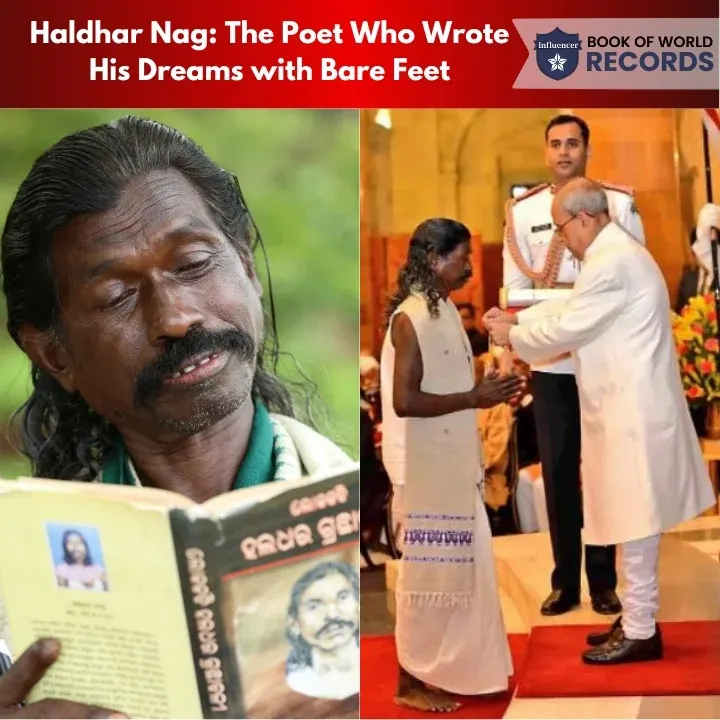
Short answer: Haldhar Nag is a Sambalpuri (Kosli) poet from Odisha, born on 31 March 1950 in Ghens village, Bargarh district. He left school in Class 3 after his father's death, worked as a dishwasher and then as a school cook, and later ran a small stationery shop. His first poem, Dhodo Bargachh ("The Old Banyan Tree"), was published in a local magazine in 1990. The Government of India awarded him the Padma Shri in 2016 for his contribution to literature. He is known as "Lok Kabi Ratna" and is famous for remembering all of his poems by heart.
In the green countryside of western Odisha, among folk songs and village fairs, lives a poet whose life story is as powerful as his verses. Haldhar Nag had almost no formal education, yet researchers now study his poetry, a university has given him an honorary doctorate, and the President of India presented him one of the country's highest civilian honours. At the Influencer Book of World Records we celebrate people who prove that talent and determination can overcome any obstacle, and few stories show that better than his.
Haldhar Nag at a glance
| Full name | Dr. Haldhar Nag |
|---|---|
| Born | 31 March 1950 |
| Village | Ghens (also spelt Ghess), Bargarh district, Odisha |
| Language | Sambalpuri / Kosli (western Odisha) |
| Education | Studied up to Class 3 |
| First poem | Dhodo Bargachh (The Old Banyan Tree), 1990 |
| Known as | Lok Kabi Ratna; "the vest poet" (for his white vest and dhoti) |
| Major honour | Padma Shri, 2016 |
| Honorary doctorate | Sambalpur University, 2019 |
| Family | Wife Malati Nag; one daughter |
Early life: from Class 3 dropout to school cook
Haldhar Nag was born into a poor family in Ghens village of Bargarh district. When he was about ten years old his father died, and he had to leave school in Class 3 to support his family. He first worked as a dishwasher in a sweet shop for around two years. He was then given work as a cook at a high school in the area, where he cooked for students for many years.
Later he borrowed ₹1,000 and opened a small stationery shop near the school. Throughout these years of hard work he kept listening to folk songs, Ramayana and Mahabharata recitals and the stories of village life, and all of this went into the poems he would later write.
Dhodo Bargachh: the first poem
In 1990 his first poem, Dhodo Bargachh ("The Old Banyan Tree"), was published in a local magazine. Readers connected with it immediately because it spoke in their own language, about their own surroundings. He sent more poems to the magazine, they were published too, and invitations to recite at village gatherings and cultural events followed. Within a few years he had become a well-known voice of western Odisha.
Language and themes of his poetry
Haldhar Nag writes in Sambalpuri, also called Kosli, the language of western Odisha. His poems and kavyas (long narrative poems) deal with:
- Nature and village life: trees, rivers, seasons and the rhythm of farming;
- Society and social reform: poverty, injustice, the dignity of ordinary people;
- Mythology and religion: retellings of stories from the Ramayana and Indian tradition;
- Local history and heroes, such as the freedom fighter Veer Surendra Sai.
His simple, musical style is often compared to that of the celebrated Odia poet Gangadhar Meher.
Famous works of Haldhar Nag
His well-known works include:
- Lokgeet
- Samparda
- Krushnaguru
- Mahasati Urmila
- Tara Mandodari
- Achhia
- Bachhar
- Siri Somalai
- Veer Surendra Sai
- Karamsani
- Rasia Kavi (on the life of Tulsidas)
- Prem Paechan
- Kavyanjali
Sambalpur University has compiled his writing in Haldhar Granthabali, and his poems have been translated into Hindi by Dinesh Kumar Mali, which helped bring his work to readers outside Odisha.
A remarkable memory: every poem by heart
One of the most talked-about facts about Haldhar Nag is his memory. Reports on his Padma Shri described how he remembers all of his poems and around 20 epics by heart: mention a title or subject and he can recite the poem. For a man who left school in Class 3, this ability to compose and preserve long works entirely in memory continues the old oral tradition of Indian folk poets, and it is a big part of why his live recitations draw such large audiences.
Padma Shri 2016 and other honours
- Padma Shri (2016): presented by President Pranab Mukherjee for his contribution to literature. He arrived at the ceremony barefoot in his usual white dhoti and vest, an image that was widely shared across India.
- Honorary doctorate (2019): conferred by Sambalpur University, which is why he is now addressed as Dr. Haldhar Nag.
- Research on his work: scholars have written doctoral theses on his poetry, and an international seminar on the Hindi translation of his work was held at Pondicherry University.
- Dr Ram Manohar Tripathi Lok Seva Samman (2022).
- In 2016 the Odisha government announced a Sambalpuri language research centre named after him in Ghens. His home there, the Padmashree Haldhar Nag Kavi Kutir, displays his awards.
Lessons from Haldhar Nag's life
- Talent does not need permission. He had no degree, no literary training and no connections, only his language and his observation of life.
- Your own language is your strength. By writing in Kosli rather than a more "prestigious" language, he gave a voice to millions of people and brought national attention to the language itself.
- Simplicity earns respect. Even after national fame he kept the same clothes, the same village and the same humble way of life.
- Memory and practice are powerful. His ability to hold thousands of lines in memory came from a lifetime of listening, reciting and repeating.
Stories like his are why the Influencer Book of World Records exists: to recognise extraordinary people from ordinary backgrounds. If you, your child or someone you know has a measurable, extraordinary talent, read how to apply for a world record (step-by-step guide) or start your record application.
Frequently asked questions
Who is Haldhar Nag?
Haldhar Nag is a Sambalpuri (Kosli) poet from Bargarh district in Odisha. He studied only up to Class 3, worked as a dishwasher and school cook, and became one of India's most loved folk poets. He received the Padma Shri in 2016.
What is Haldhar Nag's village name?
Haldhar Nag was born in Ghens village (also spelt Ghess) in Bargarh district, western Odisha, where he still lives and where his home is now a small gallery of his awards.
When did Haldhar Nag get the Padma Shri?
Haldhar Nag received the Padma Shri in 2016 for his contribution to literature. It was presented by President Pranab Mukherjee.
In which language does Haldhar Nag write?
He writes in Sambalpuri, also called Kosli, the language spoken in western Odisha.
What was Haldhar Nag's first poem?
His first published poem was Dhodo Bargachh (The Old Banyan Tree), which appeared in a local magazine in 1990.
Why is Haldhar Nag called Lok Kabi Ratna?
"Lok Kabi Ratna" means "jewel among folk poets". The title reflects how deeply his poems connect with ordinary people and the folk traditions of western Odisha.
How much did Haldhar Nag study?
He studied only up to Class 3. He left school after his father died, yet he received an honorary doctorate from Sambalpur University in 2019, and researchers have written PhD theses on his poetry.